
What’s one common trait in almost all developed and fast developing nations? Safe and equitable women’s participation in the workforce, from entry level to senior management positions. With half of the population comprising women, it makes perfect sense for every country to optimise on this vast existing resource, especially countries like Sri Lanka that have few natural resources and an aging population.
By this yardstick, Sri Lanka falls woefully behind. Until the situation is both acknowledged and corrected, Sri Lanka can never accelerate its economic and social growth, and will be doomed to meander along its current path of slow growth and can never catch up since half its population is denied the opportunity to fully participate.
The deep-rooted cultural prejudices among both men and women towards the role of women in society have clearly stunted any weak attempts to move towards a semblance of parity on the grounds of equal rights. It is therefore time to examine this issue on the basis of economic performance. By keeping women out of leadership positions, Sri Lanka is losing an essential factor in economic and social competitiveness.
Women in Sri Lankan economics and leadership
The number of women in Sri Lanka’s Parliament – already abysmal – dropped further during the recent election. The number of women in the 27-member Cabinet – ONE! The number of women among the 40 state ministers – TWO! The number of women among 63 ministry secretaries and state ministry Secretaries – EIGHT!
Think the private sector is any better? Think again. Take a look at the boards of directors of companies listed on the Colombo Stock Exchange (CSE). Apart from a token woman here and there, the boards are dominated by men. The advent of Sri Lanka’s first-ever woman CEO to head a conglomerate was heralded as a major event a few weeks ago, emphasising the rarity of the event.
Equality between men and women has been the country’s long-term political commitment. In several areas, however, gender inequality remains, undermining the economic opportunities of women and affecting the global economy. Persistent disparities cost women, children, employers, and society as a whole significantly, leaving a significant proportion of ability unused.
An incredible overall situation indeed in the country that broke a historical barrier was electing the first woman Head of Government a full 60 years ago – a country where women have exercised full voting rights since 1931 (the same time as men) and where women dominate the lower levels of the most important revenue generators: Migrant labour, plantations, and apparel.
Despite women now comprising 54% of graduates, a number that appears destined to rise further, the number of women in upper levels of management has not increased significantly, clearly demonstrating the existence of a glass ceiling.
Often, the discrimination is actually formalised through ludicrous rules. A striking example was Sri Lanka’s Police Department, which up until last year had an absolute rule that women could not be promoted further than the level of SP, which effectively barred them from holding posts of DIG that are the most important layer of command in provinces, police ranges, and police divisions. This, despite the fact that women had been a part of the Police force for 40 years. It was only after women police officers petitioned the Supreme Court that the matter was corrected.
History of digital identity cards in Sri Lanka
- According to the World Bank’s set of development indicators, collected from officially recognised sources, Sri Lanka’s female population was 52.01% in 2019
- UNDP (United Nations Development Programme) urged the government and organisations through education, awareness-raising, and increasing opportunities to use a new wave of policies to reform these discriminatory attitudes and practices. For example, taxes should be used to promote equal shared responsibility for childcare or to allow women and girls to join typically male-dominated sectors such as armed forces and IT

Fig. 1 shows the low level of women in the labour force.
The experience of many developed and emerging nations has shown that women’s abilities are very much equal to those of men. There are, of course, industries that are better suited for men physically, and the reverse is also true. Women’s firms, for example, account for between 30% and 40% of the formal SMEs in emerging markets.
Growth could be much higher in many countries if there were more women in paid jobs. Increasing the participation rate for women in the labour force of Northern Europe is estimated to raise per capita GDP permanently by 8%.
Fig. 2 shows global participation in female labour force levels in 2019. The average was 51.98% based on 182 countries. The highest is Rwanda at 83.93% with the lowest being Yemen at 5.83%.

Asia
The International Labour Organisation (ILO) survey shows that the global gender difference in labour participation is 26.7%. The gender gap is much wider in South Asia at a whopping 50.8%, and the study found that socioeconomic norms of the decision of women to engage in the workplace are substantially reduced. It also concludes that “the closure of the gender divide by 25% by 2025 could add $ 5.8 billion to the global economy and boost tax income”.
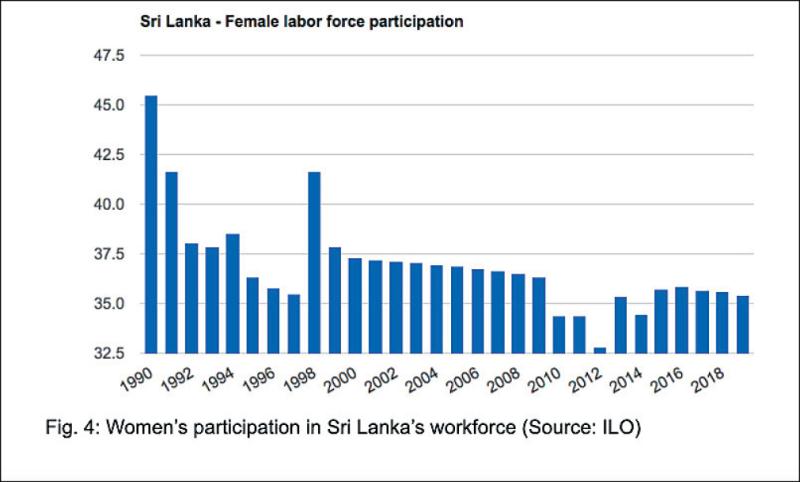
Fig. 4 shows that Sri Lanka’s average from 1990 to 2019 amounted to 36.91%, with a minimum of 32.83% in 2012 and a high of 45.51% in 1990. The most recent 2019 figure is 35.44%.
Chronic prejudice
How often do we hear women say: “I had a job before marriage, but my husband wants me to stay at home”? If it isn’t the husband, it’s the in-laws who want a dutiful daughter-in-law. The fact that she has a degree and had her own career before marriage doesn’t seem to matter much. Even after children are sufficiently grown, many women who want to get back to careers find that their contemporaries have climbed far ahead in the meantime.
Clearly in Sri Lanka, the rights and privileges of women are not equal to those of men. The country’s gender ratio and the limited available resources for girls have also been influenced by strong preferences for males. Private sectors in Sri Lanka are unwilling to employ women, or women may lack the skills required from employers. Most women graduates study arts in Sri Lanka, resulting in lower employability than administration, technology, agriculture, medicine, and engineering.
Theory of glass ceiling
In the 1980s, the term “glass ceiling” and “mommy track” became common. The impression was that when women had children, they took a long time off from work or left the workforce completely. If women returned to work, due to their maternal duties, they were often considered to be less committed employees. Thus, many companies have shifted young women to the “mommy track”, where there are fewer opportunities for promotion and opportunities to make a real impact on a company.
Globally, legal issues and a change of thought have driven many companies to give young mothers extra time off, even with compensation. Industries increasingly provide extra benefits to encourage a balance between work and home life for workers of both genders. Many benefits include flexible schedules, the freedom to bring a child to work, and even daycare facilities run by the employer.
Many male senior managers still embrace the status quo and enjoy their power role and personal bias against women who seek to enter what they see as their own territories.
Percentage of women in companies’ boards of directors
Fig. 5 shows the percentage of women on boards of directors by country.

Economic benefits of increased participation by women
- Competitiveness increases
- Boosts GDP
- Closing of ageing and knowledge workers gap
- Increase human capital (workforce)
Legal rights for women
One could fill a book with the number of Sri Lankan laws and international gender conventions that Sri Lanka’s state and private sectors are flagrantly violating. Article 12(1) of the Constitution demands equality; while Article 12(2) outlaws gender discrimination. Article 12(4) actually calls on authorities to formulate laws for the advancement of women. Sri Lanka is also party to the ILO Convention of 1958 C111 – Discrimination (Employment and Occupation).
Lessons from Asia
Malaysia has implemented an interesting practice with regard to homemakers. It transfers 2% of the husband’s salary to the EPF account of the wife, while the husband receives 9%. This is no burden for the husband since the household pay is not reduced. Social Security Organisation (Socso) is another measure, covering 1.2 million homemakers. Socso provides funds and benefits for emergencies, wounds, and death, which works as an insurance organisation.
The way forward – a practical solution
- The slow pace of practical reforms, hampered by cultural prejudices urgently dictates that decisive action is required. The authors suggest that a quota system be drawn up by the State Ministry of Women’s Affairs to bring about rapid advancement in order to increase Sri Lanka’s economic competitiveness and social progress. Such a system would need to be progressive to move women up the ladder, in that one cannot immediately order listed companies to appoint women to 50% of positions on their boards of directors as there would be a lack of experienced persons. Instead, parity should be brought about at mid-level positions and senior positions, and progressively expanded to a set time frame to the top posts. In the same manner, the percentage of women among local government, provincial, and central government bodies including Parliament, state minister posts, and Cabinet posts.
- “Housewife” is an archaic term and should be replaced with “homemaker”. In addition, due recognition should be given to homemakers, be they men or women, for the important work they do in supporting their spouses, children, and extended families. Both the state and private sectors also need to be far more supportive with regard to providing daycare facilities in order to enable their female staff to have productive careers instead of having to drop out of the workforce.
- Sri Lankan labour laws also need to be drastically reformed to remove curbs on women working, laws that flagrantly violate the equal rights enshrined in the Constitution. In addition, labour regulations with regard to maternity leave need to be reformed and paternity leave need to be introduced in order to make the burdens of parenthood more equitable.
(Dr. Nicholas Ruwan Dias and Niresh Eliatamby are Managing Partners of Cogitaro.com, a consultancy that finds practical solutions for challenges facing society and different industries.
Dr. Dias is a digital architect and educationist based in Kuala Lumpur. He holds a BSc in Computing from the University of Greenwich, a Master’s in Computer Software Engineering from Staffordshire University, and a PhD from the University of Malaya. He is completing a second doctorate in business administration from Universiti Utara Malaysia. ruwan@cogitaro.com.
Niresh Eliatamby is a lecturer in marketing, HR, and mass communications based in Colombo. He is an author and was formerly Associate Editor of a newspaper and Editor of various industry magazines. He holds an MBA from London Metropolitan University and an LLM from Cardiff Metropolitan University. niresh@cogitaro.com.)