
How our cricket can wipe out corruption and streamline management
It is no secret that Sri Lanka Cricket has, over the years, earned a reputation as an organisation rife with corruption and mismanagement. A direct result of this has been the abysmal performance of the national team in recent times.
Over the last 25 years, successive ministers of sports have made valiant attempts to turn back the tide of corruption and mismanagement by dismissing SLC boards and appointing no less than eight interim committees (IC) under many persons of great integrity. These have generally been quite successful, but their interim nature makes the changes they implement impermanent as well. Once an IC bows out, the situation goes back to square one.
SLC elections are notoriously strange, with one AGM (annual general meeting) famously dissolving into a fracas where a gun-toting gang of thugs, armed, brought in by one candidate chased off the Presidential Security Division escort of another candidate.
The evidence is overwhelming that the powers given to the Minister of Sports are insufficient to stamp out corruption, bring in greater transparency and accountability, and improve performance. Is it now time that Sri Lanka’s judiciary intervened to strengthen these areas, including more powers to the minister, to reign in corruption and mismanagement on the lines of the precedent set by the Supreme Court of India through the Justice Lodha Committee?
The powers of ministers
In Sri Lanka, cabinet ministers wield enormous powers over the industry or subject that they oversee. This is written into our Constitution and many Acts of Parliament. A minister is only kept in check by the President, the Prime Minister and rest of the Cabinet, the Auditor General, and the judiciary if called upon.
However, when it comes to cricket, which we can describe as the national passion, the Minister of Sports wields only limited powers. He has little control over who is appointed to guide and control the sport or its finances. The powers he has are mainly to select national teams through selection committees appointed by the Ministry. Although in theory the minister also has the power to dissolve any sport’s governing body and appoint an interim committee to run it, the International Cricket Council (ICC) frowns on government-appointed bodies and has in the past even suspended or demoted countries from the game, if cricket in the relevant nation is run by a government-appointed body. All that any cartel in cricket needs to do is to wait until elections are forced by the ICC and then buy sufficient votes to get back to power. As we all know, there have been several such cartels in the game of cricket in Sri Lanka over the last few decades.
With assets of over Rs. 10 billion and annual revenue often counted in billions of rupees, it is hardly surprising that SLC would be the focus for many types of nefarious individuals. Of course, many fine-upstanding people have served and do serve the SLC, but their good work is undone by the rotten apples.
It is, therefore, imperative that the governing body becomes more transparent and less susceptible to corruption, and for the minister and other independent governing authorities to be given stronger powers to oversee the functioning of the governing body.
For decades, the Constitution of Sri Lanka Cricket has been an unsolvable enigma. It gives voting rights to an enormous number of persons who may have ulterior motives and hidden agendas and may not have the best interests of cricket at heart. It was assumed that this Constitution could only be changed by a vote of the governing body itself, which was akin to asking the mafia to reform itself. The Minister of Sports appeared to have little power to change the SLC Constitution and also over the finances and management of SLC. One interim committee actually tried to change the Constitution but fell short of achieving the desired objective.
However, the recent developments in India have encouraged a group of eminent Sri Lankans who have served the sport for decades to move the Court of Appeal to order just such a judicial solution to rewrite the SLC Constitution. The mechanism for this would be a commission or committee that would be appointed by the Minister of Sports. Crucially, while the ICC opposes government intervention in cricket, it does not oppose judicial intervention.
The motion now pending before the Court of Appeal asks for just such judicial intervention to authorise the minister to appoint a separate body to rewrite the SLC Constitution. While we will not comment on the case before court, it is pertinent to the future of cricket in Sri Lanka – our national passion that unites all citizens – to seriously consider if it is now time to follow the example set by India’s Supreme Court, with all other available options seemingly exhausted.
Problems with SLC Constitution
There is little doubt that the SLC Constitution is a continuous stumbling block that has prevented meaningful reform of SLC to stamp out corruption and mismanagement and bring in greater accountability and transparency. Fig. 1 illustrates this aspect.

Some of the glaring examples include:
- The requirement that any amendment to the SLC Constitution needs a two-thirds majority vote at an extraordinary general meeting (EGM).
- The requirement that any amendment to the SLC Constitution be first discussed at an SLC Executive Committee meeting before being placed before an EGM.
- The lack of women’s representation in decision-making at SLC, despite women’s cricket being under the purview of SLC.
- No requirement to publish accounts on a regular basis.
- The astonishing number of votes and voting members eligible to cast ballots at an SLC election, totaling 147 votes, far in excess of nations such as India which has just 38 but has a population 75 times the size of Sri Lanka.
- The ability of clubs that do not possess a proper cricket ground or regularly participate in tournaments to become “Controlling Members”, which is the highest category of membership with two votes per club, or “Affiliated Members”, which is the next highest category with one vote per club.
- Despite cricket being played throughout the country, it has been developed only in four of the nine provinces – namely, the Western, Central, Southern, and Northwestern Provinces.
- Very little effective player representation in Sri Lanka Cricket.
- The lack of restrictions on tenure of office, such as cooling off periods, effectively allows office bearers to continue in office for life without interruption, as long as they win elections.
- The inability of SLC to own property, which then places all SLC property under the direct control of its four top-elected office bearers, giving them vast powers over SLC’s assets.
- No requirement of transparency as it does not come under the Right to Information Act.
- SLC has not been incorporated by an Act of Parliament. Considering the importance of cricket to the entire population, this is not a desirable situation.
- Many of the very sound recommendations for reform of the SLC Constitution suggested by the ICC’s Haroon Lorgat Committee and Justice Prasanna Jayawardena’s Report have been ignored
Governance
Modern international sports bodies must be run in the manner of global corporate citizens, with all the attendant checks and balances and safeguards. There is an enormous amount of money in major sports today through telecast rights, and proper governance methods are of paramount importance.
Corruption
The massive funds in turn attract all types of unscrupulous groups. Sri Lanka has, unfortunately, had far too many cases of corruption, and attempts to minimise this have been stifled for the most part due to the SLC’s constitutional mess.
Financial transparency
Every sports body needs to publish accounts on a regular basis – quarterly and annually. They need to account for the money spent and be open to questions on each transaction.
Monitoring and overall transparency
There needs to be a separate body, perhaps under the authority of the minister, to monitor SLC’s day-to-day activities, which should include independent persons such as the independent directors found on the boards of corporates.
Auditor General
It would be ideal if SLC was brought under the scrutiny of the Auditor General on a more permanent basis, where the Auditor General would play a more active role in auditing financial matters.
The Haroon Lorgat Committee and Justice Prasanna Jayawardena
These committees were previous attempts to persuade SLC to reform itself, the first being appointed by the ICC itself and the second being a report by Supreme Court Judge Prasanna Jayawardena. But they were never properly implemented.
Interestingly, one of the key suggestions of the ICC’s own Haroon Lorgat Committee report was that the powers of the Minister of Sports be strengthened by giving him the authority to appoint a Board of Governors that would oversee the functioning of SLC and to control all expenditure over Rs. 10 million. This would effectively halt the mismanagement of funds at SLC.
The Mudgal Committee and Lodha Committee
If there is one country where cricket is even more popular than in Sri Lanka, it is India, where it is the only sport all people of India have at heart. But it suffered through one controversy after another with major political interventions, corruption, match-fixing, betting, etc. Match-fixing and corruption became a common narrative, especially after the advent of the IPL.
Over the past eight years, cricket in India has undergone a cascade of structural transformations that have set in place many safeguards aimed at cleaning up the sport and its governing body, the Board of Control for Cricket in India (BCCI).
The transformation was sparked in 2013 when the Delhi Police made revelations of match-fixing involving several IPL (Indian Premier League) teams and made several arrests and prosecutions. However, attempts by the BCCI to whitewash influential persons involved in the scandal led to the Bihar Cricket Association taking the BCCI to court. The court ordered the formation of the five-member Mudgal Committee headed by former High Court Judge Mukul Mudgal to draw up concrete recommendations to deal with the IPL betting fiasco. This committee ordered some stern action against the perpetrators, and also recommended that the BCCI be restructured through a court process.
The Supreme Court then appointed a three-member committee headed by former Chief Justice R.M. Lodha and including two other former Supreme Court judges to look into the matter. The Lodha Committee ordered sweeping reforms that completely transformed the BCCI, although the BCCI and several regional cricketing bodies fought in court for many years to prevent their implementation. The Supreme Court finally ordered almost all of the Lodha Committee’s recommendations to be implemented, noting that the BCCI Constitution at the time was “highly incapable of achieving the values of transparency, objectivity, and accountability”. Crucially, the Supreme Court noted that the BCCI was dragging its feet and ordered a set of timelines for the implementation of the recommendations.
As a result of the entire exercise, the BCCI and many regional cricketing bodies were completely shaken to their foundations for the betterment of the game.
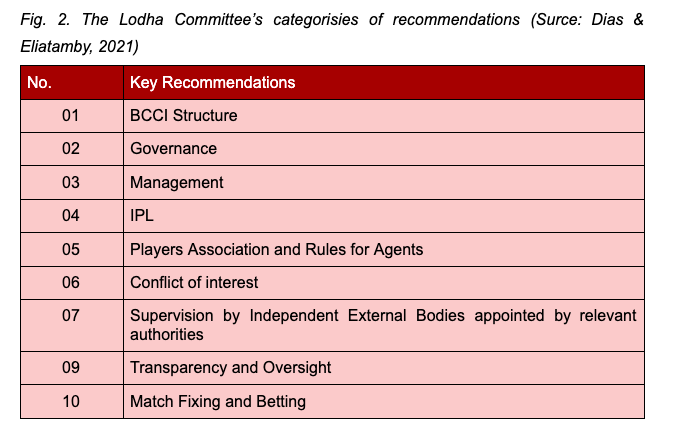
- No. Key recommendations
- 01 BCCI structure
- 02 Governance
- 03 Management
- 04 IPL
- 05 Players’ Association and rules for agents
- 06 Conflict of interest
- 07 Supervision by independent external bodies appointed by relevant authorities
- 09 Transparency and oversight
- 10 Match-fixing and betting
We have given below a few of the key changes required by the committee:
- Replacement of the BCCI Working Committee with an Apex Council and a Governing Council
- The Apex Council to be restricted to nine members including five elected, two representatives of the Players’ Association including one male and one female, one representative of the full members of BCCI, and one representative of the Auditor General of India
- Age limit of maximum 70 years for office bearers
- All states of India to be represented evenly to ensure nationwide development of the sport
- Representation of small clubs to be reduced
- Arbitrary addition and removal of members to be prevented, with proper criteria established
- Reduction of the number of votes at an AGM or EGM through abolishing or restricting of voting rights of lesser categories of members
- A formal and transparent policy for disbursement of BCCI funds to the states and clubs
- Dispersal of the concentration of power among a few individuals in order to prevent abuse of power and finances
- Minimum requirements for office bearers and elected officials
- Increased representation of women and former players
- Limits on tenure of office for office bearers and officials, including cooling off periods between terms
- Reduction of the large number of committees and subcommittees, with strict specifications on qualifications of their members
- Strict specifications for the membership of the IPL Governing Council
- Formation of a Players’ Association
- Strict rules on conflict of interest
- Establishment of special roles for governance such as Ombudsman, Ethics Officer, and Electoral Officer
- BCCI to be brought under Right to Information Act
- Transparent criteria for awarding of all contracts, including to various suppliers of goods and services
- Rules with regard to telecasting and advertisements
A key result was the reduction of full members to just 38. In comparison, SLC has 147.
Is it time for a similar judicial intervention in Sri Lanka Cricket with greater powers to external authorities including the minister? That’s the question the Court of Appeal and the minister have to figure out. The next few months will surely be decisive and will see either the resurgence or doom of this most loved sport in Sri Lanka.
Dr. Nicholas Ruwan Dias and Niresh Eliatamby are Managing Partners of Cogitaro.com, a consultancy that finds practical solutions for challenges facing society and different industries. Dr. Dias is a digital architect and educationist based in Kuala Lumpur. He holds a BSc in Computing from the University of Greenwich, a Master’s in Computer Software Engineering from Staffordshire University, and a PhD from the University of Malaya. He is completing a second doctorate in business administration from Universiti Utara Malaysia. ruwan@cogitaro.com.
Niresh Eliatamby is a lecturer in marketing, HR, and mass communications based in Colombo. He is an author and was formerly the Associate Editor of a newspaper and Editor of various industry magazines. He holds an MBA from London Metropolitan University and an LLM from Cardiff Metropolitan University. niresh@cogitaro.com.