

Last week, in the first part of this two-part article, we discussed restarting tourism in Sri Lanka under the headline “When and how we should jumpstart tourism”. This week, we focus on the role of marketing, and that too specifically digital marketing, in the revival of tourism. When global travel slowly commences, the battle to attract the limited number of international tourists will be won by countries that do the best job of executing digital marketing strategies that match their target markets and products. And your digital marketing campaign needs to be a 360-degree campaign that encompasses all aspects of digital publicity.
Tourism marketers, what are your target markets now? They’d better not still be the same as before the pandemic, because global markets have changed drastically. So to new markets you must go, or perhaps to markets that existed earlier but weren’t your focus. But whatever your markets may be, you need digital marketing in a huge way. No longer can you visit international travel fairs in London, Berlin, and Dubai to drum up business. In the travel and tourism industries, none can deny technology’s impact.
It is technology which shapes people’s way of exploring and their choice of destination. Customer satisfaction must be the main objective of any travel and tourism company as they serve customers every day. The up-to-date technological trends in the travel and tourism industries must therefore be maintained. People can conveniently book vacations and fly almost anywhere in today’s interconnected world. It is necessary to stand out from competitors and city marketing can be beneficial to this for your city and in the local tourism industry. Marketers will be able to execute city marketing strategies and reap the rewards by using the suggested aspects.
Product, audience, strategy
Marketers must first understand the product that they are selling, who their target audience is, and then develop the right marketing strategy. They must also understand why people would want to visit their country. Does their country or destination appeal to the younger generation, families, seniors, groups of friends, travellers for companies, students, business travellers or couples? Do they draw tourists who want thrills or those who want a relaxing beach break? Marketers must create a marketing plan that is most suitable for each target group. Look at domestic tourism if international travellers are sparse. Then, consider how to explore the markets of the neighbouring countries and encourage local people to visit their area. That can be achieved by emphasising your nation’s similarities in culture and language with neighbouring countries.
Target China
Going by global statistics on Covid, China is likely to be the largest and most stable tourism-generating market for a while, as western markets such as Europe and the US are staggering due to the pandemic. So it makes a lot of sense to have China as the main target market, instead of scattering your marketing efforts across the world.
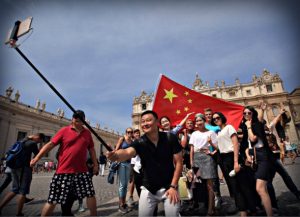
Marketers must know that western social media sites such as Facebook, YouTube, Twitter, etc., are prohibited in China. With companies worldwide using Facebook/Instagram to reach new customers, it would appear impossible to enter a new market without these. However, a range of additional channels are available for businesses to use in China for digital marketing. People in China spend a significant amount of their daily life on social networks such as WeChat.
One ‘go to’ app
Countries such as Sri Lanka have scattered their tourist information about attractions all over the place and it’s difficult for a tourist to know where to search. So have one app that provides links to city/attraction sites that can also be used for bookings, enabling a tourist to find all the information on hotels, airlines, city travel, trains, busses, national parks, cultural sites, etc. in one place.
All these locations may not be under one authority, but for purposes of digital tourism marketing, they need to be on one app, even if they continue to be under different administrative departments, ministries, etc. But remember that an app must be simple. Don’t make it too complicated to use.
Persona identification
You need to provide a website for every tourist-oriented town and attraction in Sri Lanka that a tourist could obtain all the required information from. Do you have sites for Anuradhapura, Polonnaruwa, Arugam Bay, Trincomalee, Negombo, Bentota, Yala, Wilpattu, etc.?
Next, there is a specific target demographic or a range of big target groups for a successful city marketing plan. It allows you to give careful consideration about who is most likely to be involved in travelling to your city and their reasons for doing so. You may have to split this into a variety of customer profiles. For instance, your town might be modern and prosperous, allowing it to attract younger people; be rooted in history and culture, building on old trends; or a bustling hub for business travellers; it can be a shopping centre, a shoppers’ choice, or a domestic tourism destination; it can be helpful to recognise a few main audiences to help you focus your local marketing strategy.
SEO and keywords
What are the keywords that your target customers use when looking for vacations? You need to develop your content for those keywords and the use of a variety of other methods to boost search engine placement. Marketers can also promote videos and images by using Search Engine Optimisation (SEO) principles. An on-site blog can be useful, as it provides marketers with a place to put new content to optimise their strategy.
Travel blogs
Besides creating your own website to help promote your destination, other trusted and valued travel websites like TripAdvisor should also reach your audience. For example, marketers can add pictures, stories, or videos on these sites and track country visitor feedback. Make sure each review made by visitors has a response from you, irrespective of whether your target country or city has been positively or negatively rated.
Facebook
Since people have been socially isolated lately, time spent on social media has increased significantly. Social networking is a great place to connect with past visitors and engage followers with motivational material about trips and destinations. Ask followers to share their pictures from their past stays at hotels, share inspirational pictures of their property or destination, and ask followers what their favourite activity was in the destination, and give incentives for them to do so. For example, marketers can create Facebook campaigns using the city ads on their page, and participants can be given 5-10% discounts for meals based on their participation.
Other forms of social media
Ever heard of Twitter, LinkedIn, TikTok, Instagram..? These are simply different types of digital media and your digital marketing campaign needs to utilise every single one of them. You also need to utilise social media methods that are popular in your target markets, i.e. there’s no use using Facebook in China, but there are many Chinese social media platforms that dominate that market that you can use.
YouTube
YouTube isn’t just a place where people share videos. It’s also one of the most frequently used search engines in the world. It’s also a place where travel vloggers provide massive amounts of publicity for destinations. Find out who the most popular travel vloggers are and make sure that they’re giving your destination lots of publicity.
Attract influencers
In the modern era, so-called “influencers”, who have loyal social media followers, are very important in terms of marketing. After all, many people are wise to some of the more conventional advertising and marketing platforms while others are now becoming more cynical about corporate or group marketing. While Instagram is the obvious option, Facebook, Twitter, YouTube, and even their personal blogs are other examples. By partnering with them, people who otherwise would be out of reach are seeing information about your area, and they also find these efforts more trustworthy.
Adopt data analytics
City marketing strategies are at their best when they concentrate on facts. You need to understand that your traditional knowledge is incomplete or simply wrong. But data analytics is a simple method of finding out the real situation of statistics in the digital world. City and stakeholders’ marketing organisations can obtain data on all aspects, such as recognising those who visit individual hotel or restaurant web pages by using Google Analytics to gather data. Hotels can identify their most prominent demographic markets and times. Other tour operators can gather demand trends. Marketers can also figure out how people use their favourite apps. All this information can be collected, analysed, and used at the right moment in order to create a laser-focused urban marketing campaign targeting the right people.
Data is urgently needed now that the preferences for destinations have shifted. The industry’s strategy is now digital, with data now a vital part of the recovery as a response to Covid-19. Destinations will simplify and enhance the processes, communications, and product by transitioning from conventional data to big data.
Transaction data could be used to monitor airport capacity, market sources, booking trends, programme impacts, and sentiment analysis in real time, as a solution. These data sources can improve the interpretation of people’s understanding of destinations and allow them to monitor patterns, insights, and forecasts. There is now a great chance to use data for future destination development and to plan the way ahead.
User-generated content
When you think of the occasions that you visited different cities across the globe, you would recall that you definitely wanted to learn something on each of those journeys. This is why the urban marketing strategies must also concentrate on encouraging interactions and making tourists ambassadors. Remember that those visitors can create their own content that we term “user-generated”. This can be used to promote a social media hashtag or have a video or photo section on a website. This type of indirect marketing is more convivial to many potential travellers, because it comes from ordinary people who do not have an agenda.
Virtual reality and video
Virtual reality technology offers city marketers a unique benefit, as it provides the power to allow your target audience to explore facets of your city, virtually. This can be achieved by virtual 360° tours of hotels or experiences in virtual reality that include local attractions. Less traditional video marketing material can also be effective for the visual display of your region. This can be very quickly added to YouTube, and then posted through social media, the city marketing website, other channels, as video content.
Booking engines on own websites of hotels, restaurants
A hotel booking engine for safe online bookings uses a software application. This helps guests to book directly on the hotel’s website and on websites such as Facebook whenever the hotel is mentioned. Most people use a lot of time to browse social media platforms and so it’s already a good choice to list your hotel on Facebook. But if you use the reservation system that allows guests to make a reservation via social media conveniently, this is even better.
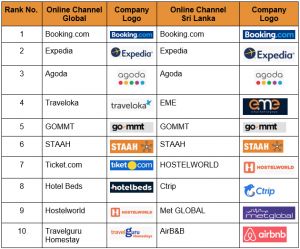
2019 top online channels: Global and Sri Lanka
Mobile and web apps
Indeed, if the rapid growth of web-based mobile systems goes on as expected, cell phones and tablets may be used by consumers to browse the internet, find information for travel, schedule vacations, make reservations, and pay for travel goods and services. The mobile internet is the core of e-tourism support and promotion. The digital world is expected to dominate all aspects of the industry in the medium term as a driving force of tourism growth.
Foreign tour operators/partnerships
Identify partnerships with organisations with an interest in building trust and obtaining new resources. This relationship may include hotels, restaurants, tour operators, tour managers, recreational agencies, or even local authorities in the country. Marketers will need to build country marketing strategies to persuade these parties to support them and contribute to their campaign to get started. They will be able to execute marketing campaigns in addition to their patented promotional strategies and create visitor interest in the target country by thinking about the goals and brand concept with these groups.
There’s a whole new world of exciting opportunities in the digital world. Go for it, marketers!
(Dr. Nicholas Ruwan Dias is a Digital Architect at Aegon Asia, based in Kuala Lumpur. He holds a BSc in Computing from the University of Greenwich, a Master’s in Computer Software Engineering from Staffordshire University, and a PhD from the University of Malaya. He is completing a second doctorate (DBA) from Universiti Utara Malaysia. Niresh Eliatamby, MBA, LLM, is a specialist in destination marketing and a lecturer on travel trade management and hospitality management in Sri Lanka for London Metropolitan University. He was a consultant for SriLankan Airlines, editor of a travel magazine, and authored several books related to Sri Lanka’s tourism industry)