
There are 92 railway stations throughout the Greater Colombo region, with hundreds of miles of rail tracks. This system can easily be developed to cater to the transportation needs of most areas, of not just Colombo but the entire Greater Colombo region. The result will be the swift reduction of road traffic, the elimination of our transport mess, and the creation of a happier and more productive population.
A global issue
City traffic jams are not a Sri Lankan problem; it’s a global one. Villages grow into towns. Towns grow into cities. Cities grow into megacities. Megacities become congested with roads lacking the capacity to cater to the transportation needs of millions of workers and schoolchildren at specific rush hours. Almost every megacity then opts for a rapid rail transport system, either on ground, below ground, or above ground. What’s true of London, Shanghai, and Mumbai, is also true of Colombo.
Our Railways’ grand vision
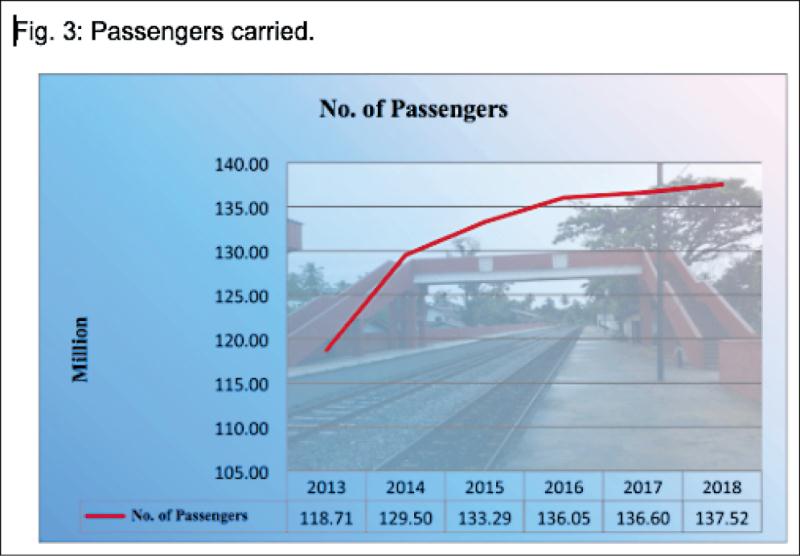
It is worth noting here that the vision of Sri Lanka Railways is: “To be the most sought-after land transport provider in Sri Lanka, providing unsurpassed value to our stakeholders.”
Sri Lanka Railways carries just 6% of Sri Lanka’s passenger traffic and 0.7% of freight. It operates only 396 trains daily (source: Sri Lanka Railways website).
Challenges
- The challenges that have prevented Sri Lanka Railways from achieving its vision include:
- Resistance to electrification of trains
- Lack of modernisation of tracks
- Resistance to introduction of modern trains
- Insufficient expansion and modernisation of stations
- Lack of co-ordination with public bus transport services to provide a complete and seamless service
- Operational and financial efficiency
- Lack of investment and maintenance
- Regular train delays
- Inadequate train frequency
- Train capacity at peak times
- Poor safety record
- Recurrent crossroads accidents
- Very high number of crossroads
- Insufficient use of ICT (information and communications technology)
A 2018 performance report from Sri Lanka Railways stated that the use of information technology procedures is a challenge, due to the lack of personnel, physical resources, and the right attitude.
For Sri Lanka, land is not an issue
In most cities, the biggest challenge in building a rail transport system is the lack of land, with available land having already been taken by buildings; thus the need to install tunnels underground or use elevated railways, which are both difficult and costly. But Sri Lanka Railways already has the land. There exist 12 railway stations within the city of Colombo – Colombo Fort, Maradana, Dematagoda, Wellawatte, Bambalapitiya, Kollupitiya, Slave Island, Secretariat, Baseline Road, Kotta Road, Narahenpita, and Kirulapone; some large, such as Fort and Maradana; some mid-sized, such as Slave Island; and some very small, such as Secretariat.
It is from the Greater Colombo region that people stream into the city on a daily basis for work and school. Within the Greater Colombo region there are a total of 92 stations. Apart from those in Colombo city, there are 31 on the Main Line up to Polgahawela, nine on the Coastal Line down to Panadura, 13 on the Puttalam Line up to Negombo, and 27 on the Kelani Valley Line up to Avissawella. These stations are almost all connected with double or triple rail lines.
The global situation
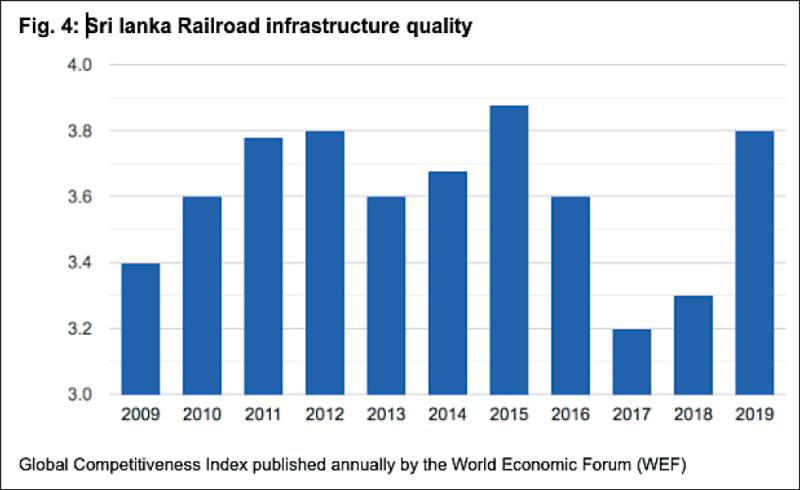
- Railway network values, (1 [low]-7 [high]), 2019 – country rankings: For 2019, the average was 3.61 points for 101 countries. The highest value was 6.8 points in Japan, and the lowest was 1.2 points for Albania. Sri Lanka was 3.8 points (Sri Lanka ranked 48)
- Rail is one of the most energy-efficient modes of transport and accounts for 8% of global motorised transportation and 7% of freight, but just 2% of energy demand for transport
- The rail network of commuter and high-speed trains has steadily expanded over the past decade, laying the foundation for easy, low-emission transport in and between cities
- With unprecedented expansion in high-speed railways, China is leading the way, and further rail investment in India and South East Asia can help to get the transport sector on track under the Sustainable Development scenario
Solutions for Sri Lanka
- Focus on developing existing railway network in Greater Colombo
- Make use of parallel lines to alleviate the volume burden on busy existing rail lines
- More detailed management by means of communications on train control improves the frequency of trains and the number of rolling stocks
- Bus routes connecting trains to ensure good intermodal connectivity
- Current rolling stock production and upgrade
- Upgrade track repair and maintenance
- Electrify the Ragama-Negombo, Avissawella, and Veyangoda-Colombo-Panadura lines
- Present the method of e-ticketing
- Encourage and extend rail freight with appropriate facilities and equipment for rolling stock
- Invest in importing locomotives and constructing local trailers
- Establish and expand freight facilities for the Colombo, Hambantota, Kankesanthurai, and Trincomalee Ports through trains
- Turn main stations into commercially viable centres and shops
Use of ICT
In the 21st Century, technology has changed many aspects of life, including the way many of us reserve train tickets. The e-ticketing system helps commuters to book tickets from the comfort of their homes and offices or anywhere in order to make buying tickets more convenient for travellers. This makes things particularly easy for those residing in remote locations.
The main benefits of using the online reservation programme are:
- Convenience – commuters can reserve or cancel tickets from their home or office
- Saves time and effort — commuters can save time for their trip by not having to wait in the queue for the railway reservation office
- Go green – commuters can also travel by presenting a soft copy of their ticket on the laptop or an SMS on their mobile phone instead of printing their ticket
Asian context
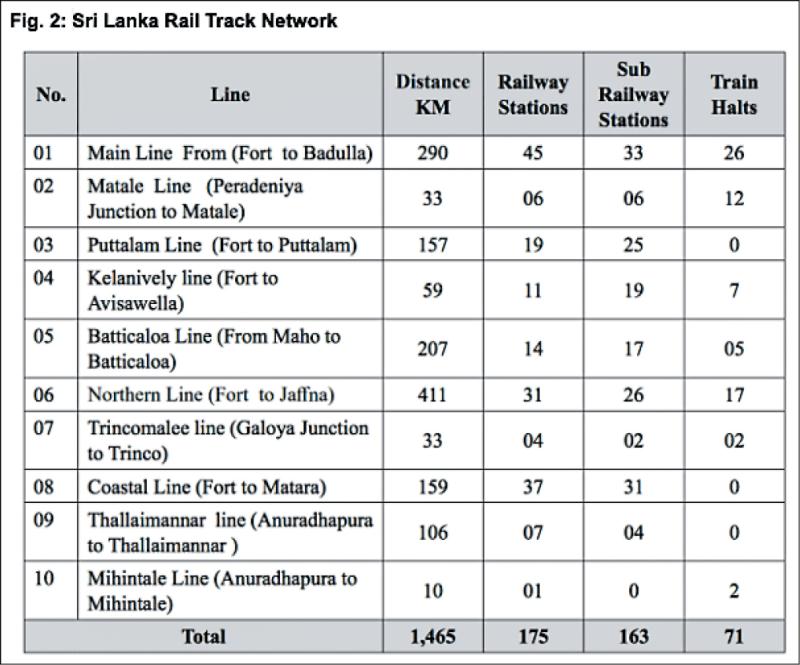
Across Asia, nations focused on development have poured investment into public transport by rail, from the bullet trains and high-speed trains of Japan and China to the super-efficient metro systems of Malaysia and Singapore. In India, city railway systems have been a focal point of investment. The Indian Railways policy of dealing with ageing engines that are barely five or six years old, as far back as the 1990s, was to introduce a highly successful domestic programme to turn diesel locomotives into electric ones. Figure 2 shows the small size of Sri Lanka’s railways.
Quick fixes
- Upgrade website (www.railway.gov.lk)
- Mobile app for e-ticketing
- LED train arrival/departure indication boards: A computerised LED train display board with an ETA and a platform not intended to operate on trains. Current information is provided from the office of the station manager. The LED screen provides full train data of the station, and is also integrated with coach signage boards and automated ads
Long term
- Usage of data-driven approach
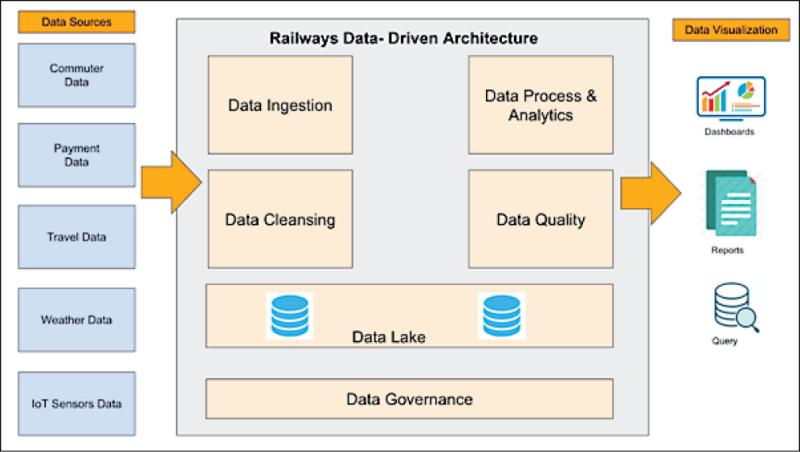
Railways departments manage an increasing amount of data that contributes to the digital economy to achieve all its capabilities. In order to provide accurate, up to date information, it provides quick, informed decisions and business benefits, as selection, review, interpretation, and forecasting are automated. This is achieved by a strong, robust, and secure architecture of information and governance. With data management in mind, the relevant information is shared across the industry and more widely, enabled by railways and their customers in developing new services and applications. Figure 5 demonstrates this.
- Optimised maintenance through IoT
Optimised maintenance keeps the train running all the time, promoting minimal train service interruption. Real-time shared asset safety tracking with a wide range of linked sensors feed the Internet of Things (IoT) together, the decision-making method for predictive maintenance. Health asset machine learning improves and increases train availability through big data analytics and artificial intelligence. Modular robustness infrastructure and units are easy to maintain and repair through an automated system that makes the operation timely, safe, and efficient.
- Flow commuters technology
Flow commuters technology entails the management of train information and the automation of the tickets gate information, camera information, other big data from existing surveillance cameras (CCTV) and video infrastructure, and utilises video analytics technology; such is the big data and machine learning technology that analyses commuters’ activity and forecasts and simulates scenarios. These technologies can analyse data from a wide range of viewpoints and visually reflect states from train congestion to station walking flows, thereby avoiding the entry of ticketless travellers and beggars.
- Advanced mobile app
E-tickets are becoming popular rapidly, conveniently, and easily in our fast-paced lives. The benefits of paperless travel both for railways and for passengers are:
- Flexibility and transparency –the electronic ticket system would make it easier for local and international visitors to make tickets reservable and remove the risk of third parties selling tickets at higher prices
- No more queues required – commuters do not have to stand in a queue or line to wait for their turn when they book their train tickets online. From the comfort of their homes and with ease of use, commuters’ tickets can easily be booked via multiple online portals. The tickets are sent to their email inbox (with QR code) after they have paid for a reservation
- Cashless and secure payment – if commuters purchase their tickets online through a secure payment portal on a website or mobile app, it doesn’t have to be paid for in person, and the process is cashless. Credit cards can be used or funds can be transferred via wire or paid through payment gateways
- Easy access to the ticket –train tickets do not have to be printed because technology used shows when commuters have made a reservation on their smartphone or on other handheld devices
- Ability to use e-wallets
Railway app personalisation features should be:
- Travel planning
- Ticketing
- Payment
- Ticket validation (QR code)
- Food orders
- Shopping
- Preference
- Share information
- Multi-commuters
- Renting device
- User navigation
- Notifications
- Location-based experience
- Real-time feedback
- Integrations to third-party systems
Conclusion
The answer to traffic in Greater Colombo clearly lies in railways, and Sri Lanka Railways is very well placed with the primary requirement of land and connecting tracks between stations. More buses on the roads would simply increase road traffic. Widening roads is a messy and costly business due to the need to acquire private lands and the resulting legal challenges.
Meanwhile, technology has made rail travel amazingly easy. An online e-ticketing system for ordinary rail tickets permits simultaneous reservations and payments and prevents unnecessary wastage of time. Commuters can maintain the travel timings efficiently if they can regularly get rail tickets online for all stations.
There is really no reason that Greater Colombo’s transport system, if rail-based, cannot rival that of Singapore or any modern city.
Dr. Nicholas Ruwan Dias and Niresh Eliatamby are Managing Partners of Cogitaro.com, a consultancy that finds practical solutions for challenges facing society and different industries. Dr. Dias is a digital architect and educationist based in Kuala Lumpur. He holds a BSc in Computing from the University of Greenwich, a Master’s in Computer Software Engineering from Staffordshire University, and a PhD from the University of Malaya. He is completing a second doctorate in business administration from Universiti Utara Malaysia. ruwan@cogitaro.com.
Niresh Eliatamby is a lecturer in marketing, HR, and mass communications based in Colombo. He is an author and was formerly the Associate Editor of a newspaper and Editor of various industry magazines. He holds an MBA from London Metropolitan University and an LLM from Cardiff Metropolitan University. niresh@cogitaro.com.